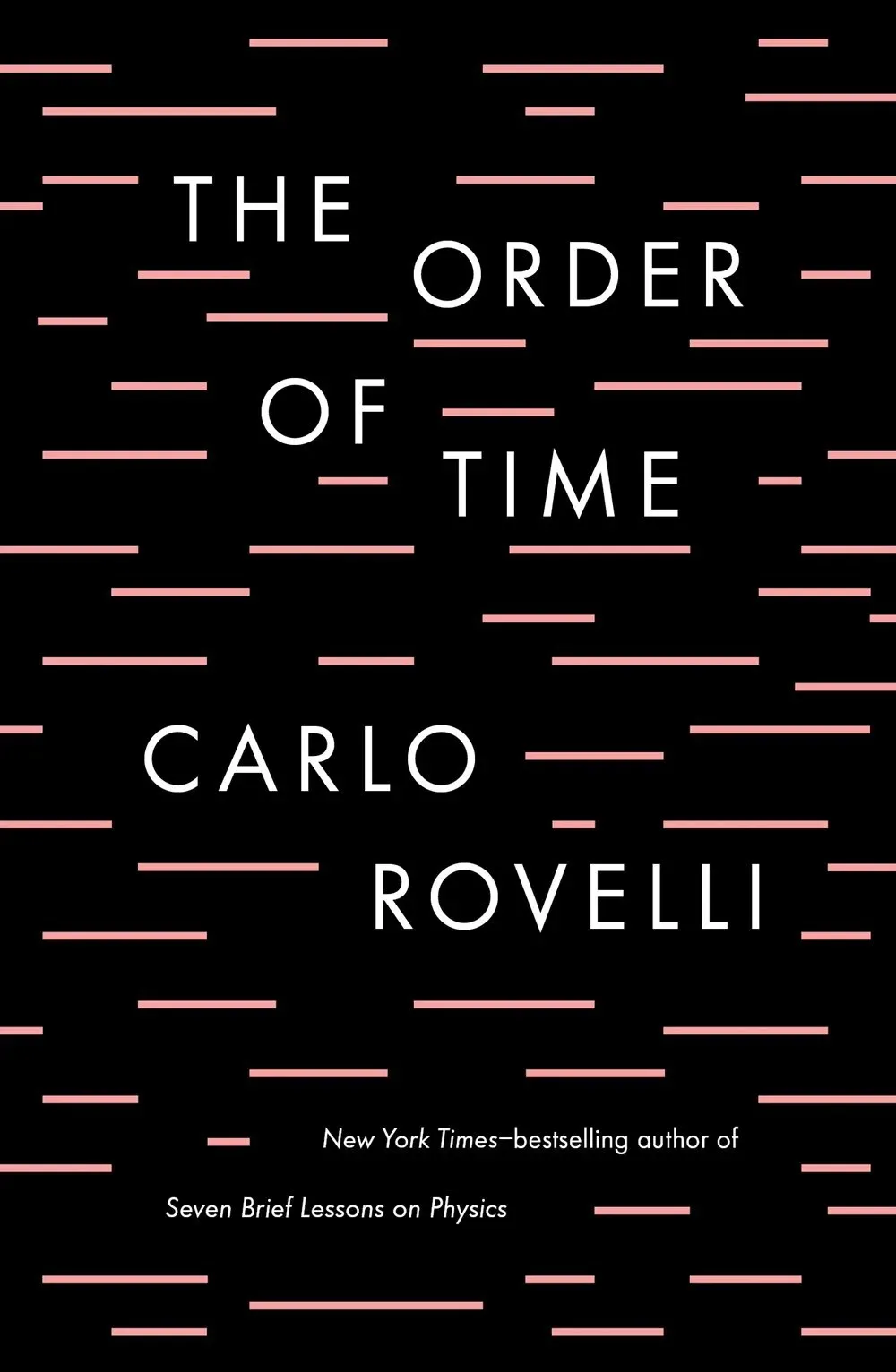
The Order of Time — Carlo Rovelli
Time is a mystery that does not cease to puzzle us. Philosophers, artists and poets have long explored its meaning while scientists have found that its structure is different from the simple intuition we have of it. From Boltzmann to quantum theory, from Einstein to loop quantum gravity, our understanding of time has been undergoing radical transformations. Time flows at different speeds in different places, the past and the future differ far less than we might think and the very notion of the present evaporates in the vast universe.
With his extraordinary charm and sense of wonder, bringing together science, philosophy and art, Carlo Rovelli unravels this mystery, inviting us to imagine a world where time is in us and we are not in time.
- p. 24 · loc. 243–247
In the elementary equations of the world,13 the arrow of time appears only where there is heat.* The link between time and heat is therefore fundamental: every time a difference is manifested between the past and the future, heat is involved. In every sequence of events that becomes absurd if projected backward, there is something that is heating up.
- p. 25 · loc. 250
Only where there is heat is there a distinction between past and future.
- p. 30 · loc. 294–296
This is what Boltzmann understood. The difference between past and future does not lie in the elementary laws of motion; it does not reside in the deep grammar of nature. It is the natural disordering that leads to gradually less particular, less special situations.
- p. 97 · loc. 822–823
the best grammar for thinking about the world is that of change, not of permanence. Not of being, but of becoming
- p. 97 · loc. 823–826
We can think of the world as made up of things. Of substances. Of entities. Of something that is. Or we can think of it as made up of events. Of happenings. Of processes. Of something that occurs. Something that does not last, and that undergoes continual transformation, that is not permanent in time.
- p. 98 · loc. 829–830
The world is not a collection of things, it is a collection of events.
- p. 99 · loc. 844–845
We cannot think of the physical world as if it were made of things, of entities. It simply doesn’t work. What works instead is thinking about the world as a network of events.
- p. 112 · loc. 949–951
What confuses us when we seek to make sense of the discovery that no objective universal present exists is only the fact that our grammar is organized around an absolute distinction—“past/present/future”—that is only partially apt, here in our immediate vicinity.
- p. 112 · loc. 952–953
We do not have a grammar adapted to say that an event “has been” in relation to me but “is” in relation to you.
- p. 173 · loc. 1491–1492
We are processes, events, composite and limited in space and time. But if we are not an individual entity, what is it that founds our identity and its unity?
- p. 174 · loc. 1496
The first is that every one of us identifies with a point of view in the world.
- p. 174 · loc. 1500–1502
The second ingredient on which our identity is based is the same as for the chariot. In the process of reflecting the world, we organize it into entities: we conceive of the world by grouping and segmenting it as best we can in a continuous process that is more or less uniform and stable, the better to interact with it.
- p. 176 · loc. 1517–1518
When we think of ourselves as persons, I believe we are applying to ourselves the mental circuits that we have developed to engage with our companions.
- p. 176 · loc. 1518–1519
We are for ourselves in large measure what we see and have seen of ourselves reflected back to us by our friends, our loves, and our enemies.
- p. 178 · loc. 1532–1533
But there is a third ingredient in the foundation of our identity, and it is probably the essential one—it is the reason this delicate discussion is taking place in a book about time: memory.
- p. 182 · loc. 1575
And hence this is what time is: it is entirely in the present, in our minds, as memory and as anticipation.