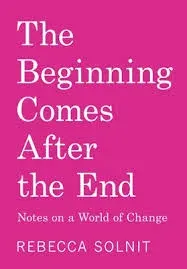
The Beginning Comes After the End — Rebecca Solnit
Rebecca Solnit offers a thrilling survey of the sheer breadth and scale of social, political, scientific, and cultural change over the past three quarters of a century.
In this sequel to her enduring bestseller Hope in the Dark, Solnit surveys a world that has changed dramatically since the year 1960. She argues that, despite the forces seeking to turn back the clock on history, change is not a possibility, it is an inevitability, and the nature of that change is determined by who participates and how.
The changes amount to nothing less than dismantling an old civilization and building a new one, whose newness is often the return of the old ways and wisdoms. In this rising worldview, interconnection is a core idea and value. But because the transformation has happened in so many disparate arenas, and within a longer arc of history, the scale of that change is seldom recognized.
- p. 12 · loc. 29–30
Whatever affects one directly, affects all indirectly.” —Martin Luther King Jr.
- p. 17 · loc. 88–95
The beginning comes after the end. A chrysalis is the beginning of a butterfly, but in that chrysalis is no elegant transition. The caterpillar falls apart—it turns to goo, and something profoundly different reconstitutes from it, guided by the hitherto dormant imaginal cells. In that slurry, the dissolving caterpillar’s immune system perceives the imaginal cells as alien and attacks them. But they survive, multiply, and set in motion the instructions to become a butterfly. A many-legged crawler becomes a six-legged winged creature, an animal that devours leaves becomes one that sips nectar from flowers. In recent years, as we’ve paid closer attention to the natural world and learned more about it from scientists, this metamorphosis has become a metaphor for the transformation of society, often with the sense that we are at the stage of dissolution, imaginal cells under attack. A butterfly is the end of a caterpillar. The beginning—the next era—comes after the end of the last one, and in between comes a lot of falling apart.
- p. 17 · loc. 95–101
There is a way to tell the story of who we were and where we were in that fall of 2024 in terms of electoral politics that is, to put it mildly, dismal and discouraging. But deeper currents of change are at work. This era is not one in which everything is fine and all ancient wrongs have been righted, but it is one in which important parts of a society, maybe a civilization, have changed profoundly, even while the right is trying to change them back. The most profound change is in worldview, when it comes to how settler-colonialists recognize and understand Indigenous presence and rights, and so many other foundational realities about our world, around gender, around race, around justice and equality, around nature itself and the science that explains it. The practical, tangible changes are consequences of these changed views.
- p. 18 · loc. 103
stability is not an option, but participating in directing change might be, if we recognize it.
- p. 18 · loc. 105–106
the poet Antonio Machado put it, on “a road made by walking.”
- p. 18 · loc. 106–107
a shift toward the idea that everything is connected,
- p. 23 · loc. 176–178
We often speak as though we are here to toil, endlessly planting and cultivating seeds and seedlings, but we have also feasted on harvests from what was sown and tended by those who came before.
- p. 25 · loc. 196–199
This is a reminder that you do not have to picture the destination to reach it or at least draw closer to it, you just need to choose a direction and keep on walking—though that metaphor makes it sound as though it already exists, if at a distance, rather than that the process itself creates it and covers the distance between the idea and the actuality.
- p. 31 · loc. 284–285
We have stories. They are seeds with which to plant forests of possibility.
- p. 39 · loc. 377–378
If knowledge is power, memory and perspective are among its most important aspects.
- p. 49 · loc. 507–508
King wrote in his “Letter from a Birmingham Jail” that “we are caught in an inescapable network of mutuality, tied in a single garment of destiny. Whatever affects one directly, affects all indirectly.”
- p. 49 · loc. 512–514
sermon “The Man Who Was a Fool,” he followed them with “I can never be what I ought until you are what you ought to be, and you can never be what you ought until I am what I ought to be. This is the interrelated structure of reality.”
- p. 50 · loc. 516–517
His introduction of nonviolence as both ethic and strategy drew from Mohandas Gandhi’s satyagraha, often translated as soul force, though King called it truth force and love force.
- p. 50 · loc. 519–527
saw his age as a transformative one, preaching (in words that echo Gramsci’s) in 1956, “Those of us who lived in the twentieth century are privileged to live in one of the most momentous periods of human history. It is an exciting age, filled with hope. It is an age in which a new world order is being born. We stand today between two worlds—the dying old and the emerging new. I am aware of the fact that there are those who would argue that we live in the most ghastly period of human history. . . . They would argue that we are going backwards instead of forward, that we are retrogressing instead of progressing. But far from representing retrogression or tragic hopelessness, the present tension represents the necessary pains that accompany the birth of anything new. . . . We are all familiar with this old world that is dying, the old world that is passing away, we have lived with it, we have seen it, we look out and see it in its international proportion and we see it in the form of colonialism and imperialism.”
- p. 51 · loc. 537
prefigurative politics,
- p. 52 · loc. 543–545
“Whereas desegregation can be brought about by laws, integration requires a change in attitudes. It involves personal and social relationships that are created by love—and these cannot be legislated. Integration will enlarge ‘the concept of brotherhood to a vision of total interrelatedness.’”
- p. 52 · loc. 554–555
If a stone is thrown into a lake, it’s the water that’s splashing, then rippling outward, not the stone.
- p. 53 · loc. 563
an eloquent voice, not a catalyst.
- p. 68 · loc. 764–766
The social revolutions of the 1960s insisted on other points of view as valuable, legitimate, and deserving and urged other people to try to see from those perspectives (including via alternative spiritual and cultural practices). And, to use a phrase that became popular, the resonance of which may be hard to understand now, to “question authority.”
- p. 69 · loc. 767–769
But what’s most striking and least noted about this old world I’ve tried to describe is how cruel it was, how much its appearance of smooth functioning relied on suppression, repression, and outright oppression, on the silencing of challenges to that hierarchy and the status quo.
- p. 70 · loc. 792–793
Perhaps cruelty is nothing more and nothing less than the exercise of inequality as the entitlement to commit harm and the lack of empathy that allows it.
- p. 71 · loc. 797–799
an old woman participating in Occupy Wall Street in lower Manhattan looked straight at the camera and said, “We are fighting for a world in which everyone matters.”
- p. 71 · loc. 803–804
what’s striking in so many of them is how normal it was to mock and make jokes at the expense of women, queer people, disabled and divergent bodies, nonwhite people,
- Note
humor is not at the expense of the other if its known thst they are loved and appreciated - whixh isnt thr case nymore
- p. 73 · loc. 824–832
the perpetrator doesn’t care about the victim, that they are not connected, that the suffering imposed on the latter doesn’t affect the former or makes the former stronger, gives them pleasure and status. The white supremacist lynchings of Black men that became the occasion for picnic gatherings and souvenir photographs have always struck me as celebrations and affirmations of disconnection demonstrated by means of the ability to enjoy oneself in the face of horrific suffering. The same goes for, in more recent times, the videos made of sexual assaults by perpetrators shared around as trophies, boasts, exercises of power and lack of empathy. Cruelty erodes when either the consequences of acts of cruelty are no longer rewarded but punished, or when the sense of separation is replaced by one of connection. In this light, the revolution in the nature of revolutions, from the 1970s to the 1990s, reflects this move toward a world in which everyone matters. L. A. Kauffman’s book Direct Action: Protest and the Reinvention of American Radicalism traces how feminist and Quaker ideas were incorporated into
- p. 74 · loc. 836–837
Quaker process of making decisions by consensus. Decision-making and running meetings by consensus seek to democratize activism, to make it inclusive and horizontal rather than hierarchical
- p. 74 · loc. 842–844
Kauffman quotes Clamshell Alliance participant Ynestra King, who says that the women’s movement had created groups “in which everyone was expected to speak, and everyone was expected to listen respectfully,” and, in the Clamshell Alliance, “Certain forms
- p. 76 · loc. 866–868
more about cooperation than obedience, more process than product, and where horsemanship is less about a perfectly executed stop or achieving a snappy flying lead change than it is about creating mutual trust and understanding.”
- p. 79 · loc. 894–895
white supremacy, misogyny, authoritarianism, transphobia, savage hypercapitalism, tragic consumerism, ecocide, and climate denial,
- p. 80 · loc. 911–912
In the 1930s, Ignazio Silone declared that “fascism was a counter-revolution against a revolution that never took place,” and the phrase has often been quoted in the
- p. 80 · loc. 915–917
The backlash is a revolt against more horizontal social forms and against a world in which everyone matters, against treating everyone with respect (not that we’ve arrived in that world, but we’ve gotten closer in some ways and places). Against a world in which everyone and everything matters, since it’s usually also anti-environmental, seeking
- p. 81 · loc. 921–922
This version of freedom is seen as inseparable from independence, and independence in turn is defined as lack of relationship or responsibility to others.
- p. 81 · loc. 924–926
considers himself, in two resonant phrases, to be “self-made” and to “not owe anything to anyone,” with literal or social indebtedness seen as oppressive obligation and unfreedom.*
- p. 82 · loc. 938–940
Categories are necessary: we think in categories; words are categories (that can be modified by other words). Thoughtfulness requires recognizing that categories are leaky, that anomalies and exceptions abound, that virtually every description falls short of the actuality. But in the ideology of isolation, blur and overlap and uncertainty and ambiguity are intolerable,
- p. 83 · loc. 953–955
conceptual and literal boundaries. A system is by definition in motion, connecting and circulating, made up of the flow of interactions and exchanges; it is a process of change.
- p. 83 · loc. 957–959
systemic discrimination do not exist, and, as conservatives regularly assert, circumstances such as poverty are the result of personal failure rather than collective structures.
- p. 84 · loc. 961–962
institutions are the only effective response to systemic problems.
- p. 84 · loc. 964–966
This ideology suits capitalism’s notion that everything can be commodified, including living beings and systems, and all commodities are disposable. (Disposal itself imagines a nowhere, a beyond, that in ecological terms does not exist; an old environmental motto was “You can’t throw anything away, because there’s no such place as away.”)
- p. 85 · loc. 971–973
climate science and climate activism both announce that everything we do has consequences because everything is connected.
- p. 86 · loc. 987
when they were not defined they were not defended.
- p. 87 · loc. 1005–1007
The term extractivism describes the ideology of taking as much as you can, giving as little as you can, disregarding the wreckage left behind. It’s the logic of colonialism and capitalism that arises from having no relationship to a place, at least none that includes a commitment to its continued thriving.
- p. 91 · loc. 1058–1061
You who are reading this, like every other human being, did not give birth to yourself or raise yourself through those first few years of absolute dependency; someone gave birth to you, and someone else gave birth to her, and so it goes; human beings emerging from other human beings down the generations and the millennia,
- p. 91 · loc. 1064–1065
For any one of us to exist, every link in the series of births and bestowal of nurture leading to us was necessary; if a single one were missing, we would not exist.
- p. 93 · loc. 1090–1092
David Graeber’s assertion in Debt: The First Four Thousand Years, that money was invented so that transactions could be finished, connections severed, that what we regard negatively as indebtedness can be seen positively as an ongoing exchange, a continuing social relationship, that is ultimately mutually beneficial, seems relevant to this desire to owe nothing to anyone.
- p. 94 · loc. 1096–1098
Writing history is often an act of disentangling, of creating the impression of a linear narrative, which sometimes clarifies and sometimes simplifies, and sometimes the simplification becomes a stripping down of context to create the appearance of coherence at the cost of meaning
- p. 99 · loc. 1160–1161
One of them saw networks. The other saw hierarchies.”
- p. 99 · loc. 1169–1170
She proposed that evolution proceeds through, so to speak, marriages rather than divorces—two species coming together rather than one splitting apart.
- p. 100 · loc. 1175–1176
holobionts, to describe how none of us is really a single species but a package that includes the bacteria, fungi, viruses, and other microbes on which we depend for our survival,
- p. 102 · loc. 1213–1214
waiting for dad the provider.
- Note
peovider vs contributor
- p. 103 · loc. 1217–1219
Adam Smith theorized the inevitability of capitalism by ignoring the unpaid labor of women, including his own mother, who tended to his needs into her old age—he outlived her by only two years.
- p. 104 · loc. 1233–1234
On the national and global scale, we have no absolute shortages, only distribution problems and a lot of waste, from uneaten food to unused second homes.
- p. 105 · loc. 1241–1243
own thriving depends on the thriving of those people and systems around you, might alter the emotional and spiritual poverty of a worldview driven by notions of scarcity and competition.
- p. 105 · loc. 1250–1251
Many of these economic theories were premised on the existence of the rational individual, who wasn’t really humanity,
- p. 105 · loc. 1252–1255
who has internalized capitalism as an ethos of “give as little and take as much as you can”). Countless examples exist of how traditional cultures took care of the land and established practices and rituals to protect the continued abundance of plants and animals by limiting the time, means, and quantity taken.
- p. 106 · loc. 1258–1260
huge quantities of non-capitalist and anticapitalist activities take place every day in most of our lives and communities. They write, “What is usually regarded as ‘the economy’—wage labor, market exchange of commodities and capitalist enterprise—comprises but a small subset of the activities by which we produce, exchange and distribute values.”
- Note
our entfire infrsfrucfure is non capitwlist projrct paid for by communal funds in form of taxes
- p. 106 · loc. 1265–1266
Peter Kropotkin, the anarchist revolutionary and astute naturalist whose 1902 book Mutual Aid: A Factor of Evolution is still a valuable overview of human and animal communities.
- p. 133 · loc. 1619–1621
It’s a deft reversal of the convention in which Europeans spread civilization and impact traveled from east to west, not the other way around. In other words, Indigenous worldviews and values were hugely influential then.
- p. 134 · loc. 1623–1628
Recognition of our inseparability from nature has grown significantly in recent decades. In the early 1990s, I heard a New York artist say to us on the West Coast, “You don’t understand. Nature for us is in the past tense.” In those days, I often encountered the view that nature and culture were opposing and more or less equal phenomena, and nature was maybe optional. It was a view in which nature was pristine scenery way out there, not an all-pervasive part of life on earth including the food that became our bodies, the soil it came from, the water we drink, the air we breathe, our own animal selves.
- p. 136 · loc. 1648–1652
The rise of Indigenous influence, the shift in scientific understanding, the return to a view of nature as essential and omnipresent, the move toward more equality and inclusion, brings into focus the change in how we tell the overarching story of the last five hundred years and more. Rather than telling it as the triumph of European and Christian civilization, we increasingly narrate it as one of destruction and division, the result of a worldview driving a society that was tremendously powerful and also tremendously harmful.
- p. 138 · loc. 1676
processual biology looks at the world as made up of processes rather than objects,
- p. 139 · loc. 1685–1688
many definitions of each of us as individuals attempt to describe a discrete and autonomous being by denying the constant flow—the breaths of air, the gulps of liquid, the bites of solids that keep us going, the more complex exchanges that are sex and reproduction, conversation and mutual aid, society and community, to say nothing of the microorganisms within us we depend on for our most crucial functions, and the other species for other aspects of our survival.
- p. 140 · loc. 1703–1707
the heady feeling of leaving the house to step into a world where you were on your own, resourceful in navigating space, maybe with a paper map or just an inner compass and memory, choosing routes, hailing taxis, finding pay phones if communication was needed, keeping appointments and sticking to plans that could not be renegotiated a dozen times en route, the necessity of talking to strangers, of being intrepid in public and present in shared experience that began to be erased by portable cassette players, and then iPods and then smart phones.
- p. 140 · loc. 1707
Baba Ram Dass’s Be Here Now;
- p. 140 · loc. 1708–1711
I also remember all the oppressions of my youth yet to be named, all the silences around all the abuses, all the inequalities yet to be recognized and denormalized, all the forms of separateness enforced in various ways. Since we don’t live at the end of history, I assume that new light will be shed in more dark corners, new frameworks of what justice and equality should look like will arise. That we are, as ever, in the middle of the story.
- p. 141 · loc. 1711–1712
hope has come from both the future and the past,
- p. 141 · loc. 1713–1717
socialist geographer Mike Davis drew hope from that past he lived through and participated in, saying to an interviewer not long before his death at age seventy-six, in 2022, “This seems an age of catastrophe, but it’s also an age equipped, in an abstract sense, with all the tools it needs. Utopia is available to us. If, like me, you lived through the civil rights movement, the antiwar movement, you can never discard hope. I’ve seen social miracles in my life, ones that have stunned me—the courageousness of ordinary people in a struggle.”
- p. 141 · loc. 1718–1720
But it’s the past that shows us the possibilities, how the world was changed, how power can appear in places and among peoples assumed to be powerless and irrelevant, how the most foundational things can be transformed, how ideas and arts matter in making the world.
- p. 144 · loc. 1761–1762
Erin Thompson, a scholar of public monuments,
- p. 145 · loc. 1768–1773
Anand Giridharadas published a remarkable essay. He wrote, “I see then that this is both a very dark time and, potentially, a very bright time. It’s important to hold these truths together. When I look down at the ground of the present right now, I feel depressed. If I lift my head to the horizon, I see a different picture. This is not the chaos of the beginning of something. This is the chaos of the end of something. And on matters of race and identity, the Trump era doesn’t have the crackle of a launch. It has been a mourning. A mourning for white power. A mourning for a time when simply to be white and show up was enough. A mourning for an era in which simply to be a man, and not necessarily an especially capable one, could get you ahead of other people.
- p. 145 · loc. 1777–1779
Arundhati Roy had put it another way in her address to the World Social Forum in 2003: “Another world is not only possible, she’s on her way. Maybe many of us won’t be here to greet her, but on a quiet day, if I listen very carefully, I can hear her breathing.”
- p. 146 · loc. 1790–1791
future is foreordained, decided, rather than something that we’re making—or competing to make—in the present.
- p. 148 · loc. 1809
adrienne maree brown in Emergent Strategy.
- p. 148 · loc. 1811
we face the past to remember, we face the future to dream.