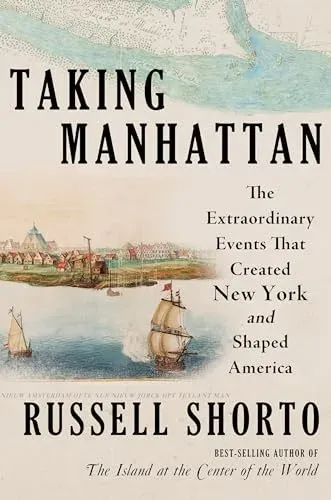
Taking Manhattan — Russell Shorto
A New Yorker Best Book of the Year
A Kirkus Best Book of 2025
One of Literary Hub's Most Anticipated Books of 2025
The author of The Island at the Center of the World offers up a thrilling narrative of how New York—that brash, bold, archetypal city—came to be.
In 1664, England decided to invade the Dutch-controlled city of New Amsterdam on Manhattan Island. Charles II and his brother, the Duke of York, had dreams of empire, and their archrivals, the Dutch, were in the way. But Richard Nicolls, the military officer who led the English flotilla bent on destruction, changed his strategy once he encountered Peter Stuyvesant, New Netherland’s canny director general.
- p. 7 · loc. 137–138
It was an invention. Hundreds of people on both sides, representing a variety of nationalities, religions, and languages, took part in that act of invention.
- p. 8 · loc. 150–151
One could argue that the East India Company has had a greater impact on the world than any other company in history.
- p. 10 · loc. 174–175
pluralism—and the notion of a society made up of a mix of different kinds of people as a core value—into New York’s foundation and America’s collective identity.
- p. 15 · loc. 208–211
Chapter 1 The Invader New York is all about water. Reasonable people may disagree with this assertion. Surely New York is about trade, finance, power. Fashion, food, art, media, design. Fusions
- p. 15 · loc. 211
Fusions and factions.
- p. 99 · loc. 1390
Instead of a society of serfs and nobles, it became one of entrepreneurs.
- p. 201 · loc. 2830–2831
“city on a hill” sermon,
- p. 321 · loc. 4500–4501
Out of that pluralism came the city’s tradition of factionalism, which in turn made it an ongoing breeding ground of ideas.
- p. 321 · loc. 4506–4509
To this day the United States is in a tug-of-war between religious tribalism and secular pluralism. I think there’s a case to be made that that struggle goes back to the seventeenth century, to the settlement of the Puritan colonies and the invention of New York. That invention paved the way for a society based on pluralism and capitalism. Its texture was evident to newcomers in the decades
- p. 322 · loc. 4515–4518
isn’t the combination of pluralism and capitalism the glue that holds all modern cities together? The unspoken creed of densely packed urban dwellers is that we will give each other space and respect; that, even though I may not understand your language or your way of looking at things or particularly care about your culture, I’ll make room for you, and maybe something new will come of our being here together.