Ikigai Diagram
A blank Ikigai diagram to print and fill in — four overlapping circles for what you love, what you're good at, what the world needs and what you can be paid for. Used in the SVA DSI Mapping class.
A worksheet for mapping what you love, what you're good at, what the world needs and what you can be paid for.
Ikigai (生き甲斐) is a Japanese word that roughly translates to "a reason for being" — the thing that gets you out of bed in the morning. The Venn diagram version, four overlapping circles, is a Western adaptation that has become a popular tool for thinking about work and purpose. It's a simplification of the original idea, but a useful one: it makes visible where the things you care about, the things you're capable of, the things people need and the things that pay overlap — and where they don't.
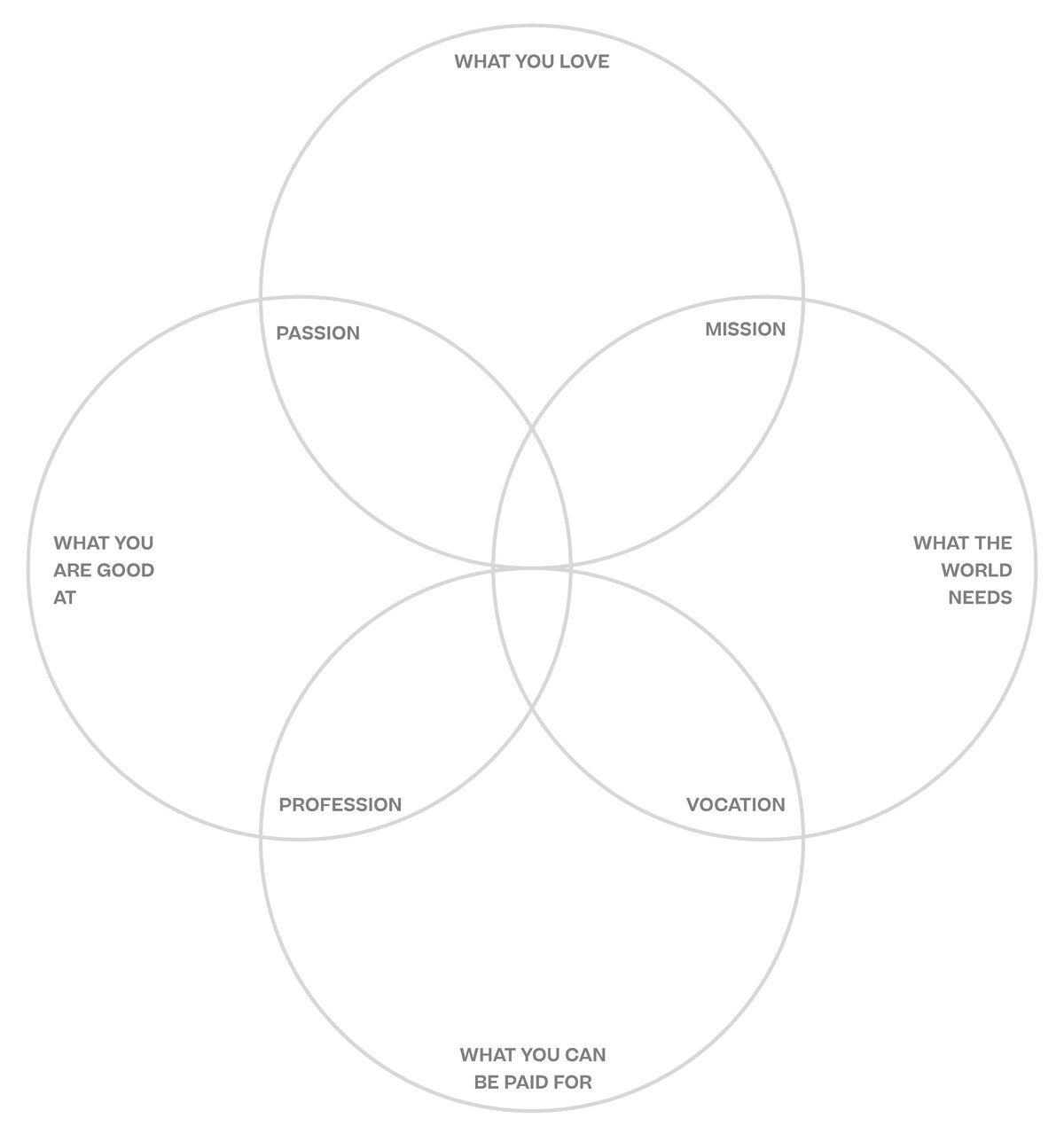
The four circles
- What you love — the activities, subjects and problems you'd pursue without being asked.
- What you are good at — skills, talents and strengths, including the ones that don't show up on a résumé.
- What the world needs — problems worth solving; people, places or communities you want to help.
- What you can be paid for — the things someone will actually pay you to do, now or plausibly soon.
Where two circles overlap the diagram names the combination: Passion (love + good at), Mission (love + world needs), Vocation (world needs + paid for) and Profession (good at + paid for). The center, where all four meet, is your Ikigai.
How to fill it in
- Print the PDF (link below) or open it in a drawing app. Give yourself 20–30 minutes without distractions.
- Start with the outer circles. Take each of the four one at a time and write down everything that comes to mind — short phrases, not sentences. Aim for at least five items per circle. Don't filter yet; be honest rather than aspirational, and include things that feel too small or too obvious.
- Look for overlaps. Go through your lists and see which items show up in two circles. Move or copy those into the overlapping areas — Passion, Mission, Vocation, Profession. Some items will only fit in one circle; that's fine and worth noticing.
- Work toward the center. Is there anything that belongs in three circles? In all four? If the center is empty, that's a finding too — look at which circle is missing and what would need to change for something to move in.
- Step back and read it. Where is the diagram crowded and where is it thin? Which circle was hardest to fill? Circle the two or three items that feel most alive and write a sentence about each one.
- Revisit it. Ikigai isn't a one-time exercise. Date the sheet and come back to it in a few months to see what has shifted.
A few tips: don't try to make the four circles balance — most people's diagrams are lopsided, and that lopsidedness is the useful information. And treat the "paid for" circle as a reality check, not a limit: it's the circle most likely to change as you learn what the world will pay for.