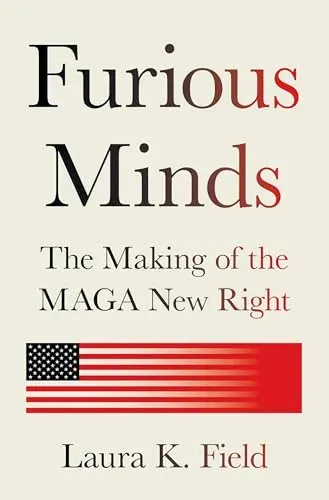
Furious Minds — Laura K. Field
The story of the radical conservative intellectual movement shaping Donald Trump’s agenda—and how it threatens American freedoms, values, and democracy
Donald Trump is not a big thinker, but his 2016 presidential victory presented a grand opportunity for people who are, and it set off a radicalization and reconfiguration of the American conservative intellectual world. In Furious Minds, Laura Field, who spent close to a decade in conservative academic circles, chronicles the rise of the New Right—the network of academics, public intellectuals, and influencers who provide ideological fuel to Trumpism. This movement includes figures such as Patrick Deneen, Christopher Rufo, Peter Thiel, and JD Vance. Their agenda is built to last, and it has dire long-term implications for liberal democracy.
- p. 3–4 · loc. 304–307
Right policy suite at the state level. Michael Anton, who was one of the first to defend Trumpism in intellectual terms, defined it in September 2016 as “secure borders, economic nationalism, and America-first foreign policy.”
- p. 4 · loc. 310–311
a staunch social traditionalism and rejection of liberal pluralism and egalitarianism;
- p. 5 · loc. 330–337
the New Right into three groups: the Claremonters, the Postliberals, and the National Conservatives. In brief, the Claremonters idolize the American founding, the Postliberals a particular (religiously inspired) conception of the “Common Good,” and the National Conservatives the myth of a traditional American nation. These camps are not mutually exclusive; it is best to think of the New Right as a highly networked movement with distinct clusters and modes of thinking, that is home not only to intellectuals, but also to activists, influencers, staffers, and politicians. The Claremonters are closely networked with the Claremont Institute, a think tank in California, and the political science faculty and administrators at Hillsdale College in Michigan. Many of the scholars in this cluster identify as West Coast Straussians—a school of thought inspired by the twentieth-century political philosopher Leo Strauss and his student Harry V. Jaffa. They rally around a particular vision of the American founders—a vision that they are desperate to recover but
- p. 8 · loc. 386–388
The movement is, in many respects, untethered from the ordinary decency and common sense that characterize America at its idealistic best—and from the pluralistic reality of the country as it exists today.
- p. 9 · loc. 400
the QAnon conspiracy, or the ongoing impact of the Prosperity
- p. 9 · loc. 400
Prosperity Gospel,
- p. 14 · loc. 491–493
If the old establishment stood on the three pillars of social conservatism, fiscal conservatism, and foreign interventionism, the New Right stands on four: social conservativism (Reno’s strong gods), economic nationalism, isolationist foreign policy, and anti-immigration (Anton’s trifecta).
- p. 15 · loc. 521–523
Cas Mudde defines populism as an ideology “that considers society to be ultimately separated into two homogeneous and antagonistic groups, ‘the pure people’ and ‘the corrupt elite,’
- p. 16 · loc. 524–525
For Mudde and others, the twin pillars of populism are anti-elitism and antipluralism,
- p. 16 · loc. 532–533
Frederick Douglass called “the composite nation.”
- p. 17 · loc. 560–562
“unmoored from lived reality, the autocrat has no need to be consistent. In fact, the ability to change his story at will is a demonstration of power.”36 Gessen named this phenomenon “The Power Lie.”
- p. 20 · loc. 612–614
The Ideas First approach is typical of the conservative intellectual world and is captured by popular right-wing catchphrases like “politics is downstream from culture” and “ideas have consequences,”
- p. 24 · loc. 676–677
America’s reactionary intellectuals are armed with more than greed and prejudice.
- p. 26 · loc. 713
coeval
- p. 27 · loc. 722
“In your guts, you know he’s nuts.”